

Why Real Estate Companies Need a Unified Platform in 2026
eal estate has always been a relationship-driven business. But in 2026, the companies that are growing fastest are the ones that have figured out how to pair strong relationships with efficient technology. The challenge most face is not a lack of tools. It is the opposite: too many disconnected tools creating data silos, manual workarounds, and lost opportunities.
If your sales team uses one system, your marketing another, your listings sit in a spreadsheet, and your website operates independently from your CRM, you are not just inefficient. You are leaving revenue on the table.
The Real Cost of a Fragmented Tech Stack
Many real estate businesses have grown organically, adopting one tool at a time to solve immediate problems. A CRM here, a website builder there, a separate portal for agents, another for clients. Each tool might work well in isolation, but together they create friction.
Data entered in the CRM does not automatically appear on the website. A property status change requires manual updates across multiple systems. Lead information captured through a portal or website form needs to be re-entered or exported and imported. Every manual step introduces delay and the risk of error.
For a company managing dozens or hundreds of listings, these inefficiencies add up quickly. Sales cycles lengthen. Marketing materials go out with outdated information. Agents and clients experience delays that erode trust.
What a Unified Platform Actually Means
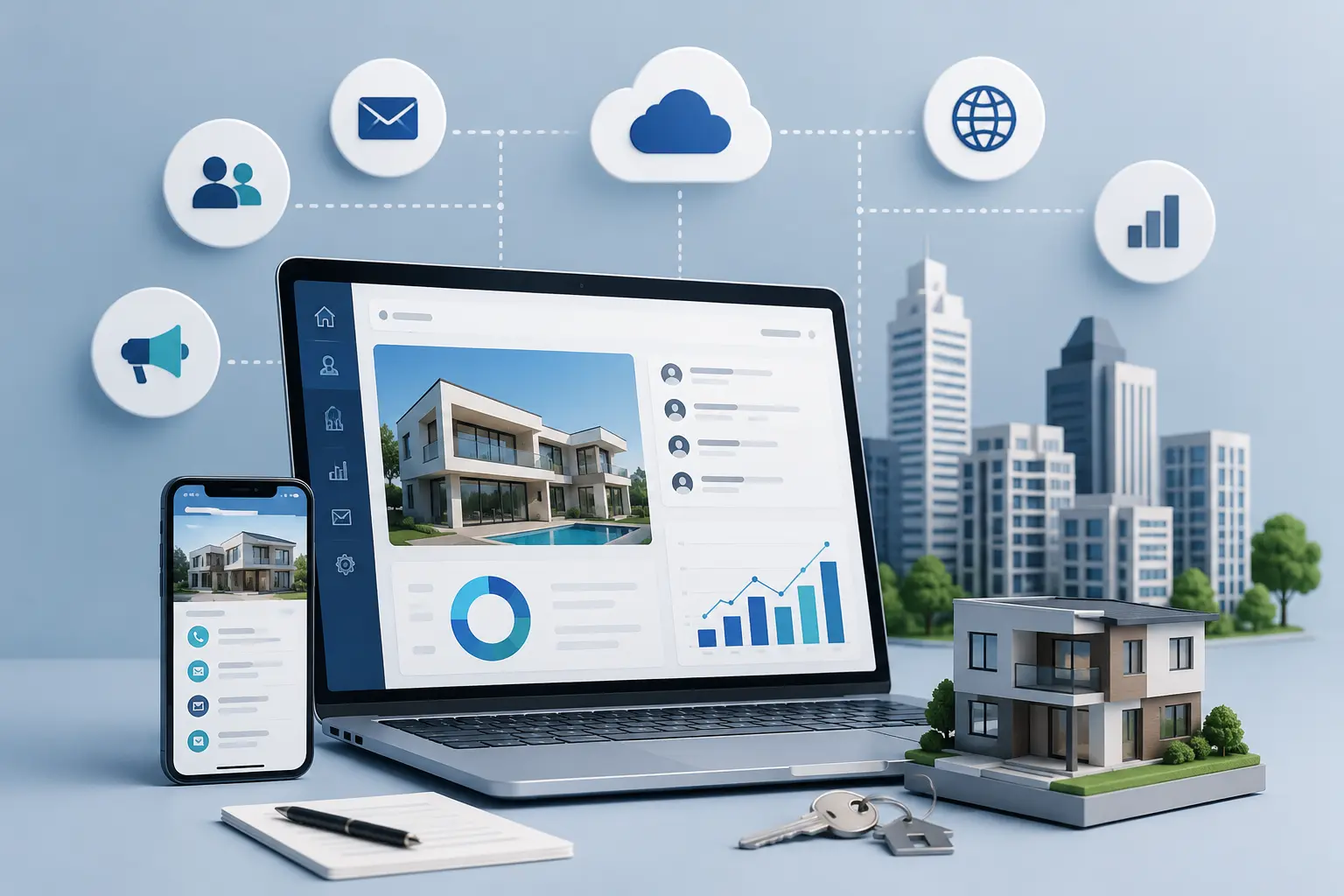
A unified platform is not simply a CRM with a few integrations bolted on. It is a single ecosystem where every component shares the same data layer and works together natively. When a listing is updated in the CRM, the website reflects it immediately. When a lead submits an enquiry through the website, it appears in the CRM without delay, assigned to the right agent, with full context.
This means your CRM, your website, your marketing tools, your reporting dashboards, and your communication channels all operate as one system. No exports, no imports, no syncing delays.
For property developers, this kind of integration means real-time visibility into project status, automated sales workflows, and seamless communication with external agents. For brokers and agencies, it means listings are always current across every channel, marketing material is generated directly from live data, and leads are captured and routed automatically.
Five Signs Your Business Has Outgrown Its Current Setup
First, your team spends time copying data between systems. If anyone in your organisation is manually transferring information from one platform to another, that is a clear signal. Second, your website shows different information than your CRM. Price changes, availability updates, and new listings should propagate automatically. If they do not, you have a synchronisation problem.
Third, you cannot generate a property brochure or marketing asset without leaving your CRM. Modern platforms can auto-generate branded collateral directly from listing data. Fourth, lead response times are slow because enquiries arrive through multiple channels with no central routing. Every minute of delay reduces conversion probability. Fifth, reporting requires exporting data to spreadsheets. If your CRM cannot provide real-time dashboards that your team actually uses, it is not doing its job.
The Connectivity Factor
Even with a unified platform, real estate companies need to connect with the wider ecosystem. Properties need to be syndicated to international portals like Idealista, Rightmove, Spitogatos, and Properstar. Leads from Facebook advertising need to flow into the CRM automatically. Data needs to move to tools like Mailchimp for email campaigns or Google Sheets for ad-hoc analysis.
This is where open APIs and integrations with platforms like Zapier become essential. A well-designed platform provides native portal syndication so listings are published across major real estate portals with a single action, and a REST API that allows programmatic connection to any external system. This combination of internal unity and external connectivity is what separates a modern real estate platform from a legacy CRM.
What to Look for When Evaluating Platforms
When assessing whether a platform is truly unified, look beyond the feature list. Ask whether the website is built from and updated by the same data as the CRM. Ask whether leads captured through any channel appear instantly in one central system with full attribution. Check whether reporting is live and customisable, not dependent on manual data pulls. Verify that the platform supports automated matching between properties and buyer requirements.
Ease of onboarding matters as well. A platform that takes months to implement and requires extensive training will not deliver value quickly. The best systems are intuitive enough that teams can start using them within days, with a learning curve measured in hours rather than weeks.
The Bottom Line
The real estate industry is becoming more competitive and more data-driven every year. Companies that continue to operate with disconnected systems will find themselves at an increasing disadvantage. Those that consolidate their operations onto a single, purpose-built platform gain speed, accuracy, and the ability to scale without proportionally increasing overhead.
The question is no longer whether you need a unified platform. It is how quickly you can move to one.
Ready to see what a unified real estate platform looks like?
Visit qobrix.com to book a demo and explore how Qobrix brings your CRM, website, portals, and marketplace into one seamless ecosystem.
Search

Sign up to our
Blog
Get the latest industry news, product updates and more. Plus receive our FREE real estate hashtags cheatsheet!